0:00
You know, I've reviewed all types of
0:01
internet services right here on this
0:03
channel. And by some of the comments on
0:05
my YouTube videos, you might think that
0:08
you've got no choice in the matter. It's
0:10
either fiber or nothing. It's just not
0:13
that simple. And what I'm about to share
0:15
with you today is going to help you find
0:17
the best internet option for your
0:19
household and maybe save you some money,
0:21
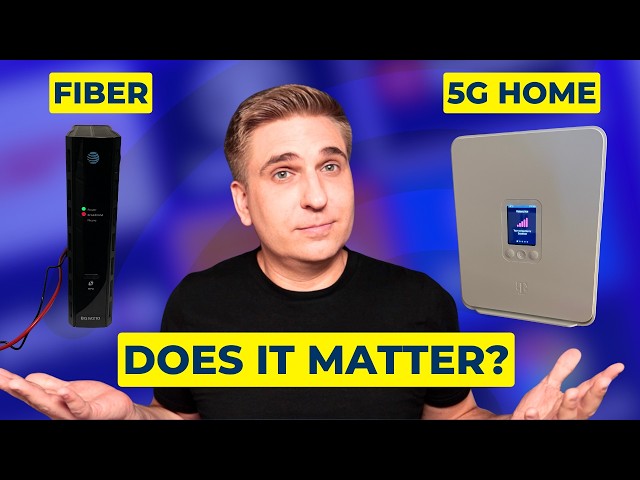
too. I started a long-term test of 5G
0:24
home internet back in 2022. first with
0:28
T-Mobile and later testing Verizon and
0:31
AT&T. And for the past three years in
0:33
counting, I've been using 5G
0:35
exclusively. No fiber backup, no cable
0:39
safety net. So, why don't I begin with
0:41
where I actually agree with those
0:43
comments I showed earlier. Where fiber
0:45
is available, it is typically best from
0:48
a performance standpoint. Most fiber
0:51
providers lead with their best selling
0:53
point and that is the speeds. The
0:56
biggest advantage is symmetrical speeds,
0:58
and you can see that in this chart from
1:01
AT&T Fiber's website. Your upload speed
1:04
matches your download speed. You don't
1:06
get that with cable or 5G home internet.
1:10
So that means with fiber, whether you're
1:12
streaming a show, hopping on a Zoom
1:14
call, or uploading files for work,
1:16
you're going to get the same fast speeds
1:18
in both directions. So, does that mean
1:21
you need fiber to do all that stuff? Of
1:24
course not. But there are some
1:26
trade-offs with 5G home internet. 5G
1:29
home internet services rely on cell
1:31
phone towers, and depending on factors
1:33
like your proximity to those towers and
1:36
any obstructions that may be in the way,
1:38
your performance can vary quite a bit.
1:41
Even the location of the gateway inside
1:43
your home can make a difference. The
1:46
providers post speed ranges like these,
1:48
and you might fall on the low end, the
1:50
high end, or even outside these ranges
1:53
entirely. And another factor to
1:55
consider, network congestion. When the
1:58
5G network gets busy, your speeds may be
2:01
slowed down and there's really nothing
2:04
you can do about it. So, your exact
2:06
experience with 5G home internet is kind
2:09
of hard to predict unless maybe you've
2:11
got a close neighbor who's got it, but I
2:14
thought I'd share my experience anyway.
2:16
And after several years of testing,
2:19
streaming TV has worked reliably. And
2:21
you might be surprised by this. Netflix
2:23
recommends only 15 megabits per second
2:26
for 4K streaming. So when you see people
2:29
saying they need gige internet, it's
2:32
definitely not just for streaming. But
2:34
do watch out for this. Some live TV
2:36
streaming services like Hulu Plus live
2:39
TV are not compatible with 5G home
2:42
internet and that's because of dynamic
2:44
IP addresses. YouTube TV and most other
2:48
streaming services will work out just
2:50
fine. General web browsing like checking
2:52
your email, online shopping and online
2:55
banking, absolutely no issues at all and
2:58
the same for using smart home devices
3:00
like security cameras. Now, I was most
3:03
concerned about working from home, but I
3:06
have been able to run Michael Saves
3:08
using 5G home internet plus some
3:10
freelance work as well that requires a
3:13
VPN, multiple programs at once, and the
3:16
occasional Zoom call. So, if you're
3:19
getting the advertised speeds for 5G
3:21
home internet, all of those tasks should
3:23
check out just fine. A couple though
3:26
could be more challenging. First, and
3:28
perhaps the biggest deal breaker for
3:30
many households is multiplayer gaming.
3:33
5G's ping can be inconsistent. So, if
3:36
you need low latency for competitive
3:38
gaming, it is not the first choice. But,
3:41
if you're like me and just play games on
3:43
your phone to pass time, you'll probably
3:46
be okay. And as I mentioned earlier,
3:48
upload speeds on 5G, they are not
3:51
symmetrical. They're going to be slower
3:53
than your download speed. So if you're
3:56
constantly uploading massive files and
3:58
on a tight deadline, that could be a
4:01
real issue. Over the years, I've
4:03
uploaded hundreds of videos on 5G,
4:05
including 4K content and client work,
4:08
and it's really never been a problem.
4:10
But my uploads have not been urgent,
4:13
just a ballpark. But most videos I make
4:16
upload in about 10 minutes or less. And
4:19
there's also larger households. If
4:21
you've got lots of people using lots of
4:23
devices all at the same time, 5G's
4:26
modest download speeds may struggle with
4:29
that. All right. So, if we're talking
4:30
strictly about performance, fiber wins.
4:33
But there is one main area where 5G can
4:36
beat all other internet providers, and
4:38
that is on pricing. No contract plans
4:40
for 5G home internet start at around $50
4:44
a month, sometimes less if you bundle
4:47
with phone service. And because of the
4:49
recent deal war, price guarantees for up
4:52
to 5 years are common. Plus, 5G home
4:55
internet is plug and play. No technician
4:58
visit, no installation fee. I believe
5:01
more competition is better, and that is
5:04
the reason why I've been following these
5:06
services so closely. While fiber is
5:09
better from a technical standpoint, I
5:11
think 5G home internet provides a solid
5:14
alternative as long as you're a price
5:16
sensitive customer with everyday
5:18
internet needs. Give this video a like
5:21
if you found it helpful and use the free
5:23
tool on michaelssteels.com
5:26
to compare the best internet options
5:28
where you live. Thanks for watching.